


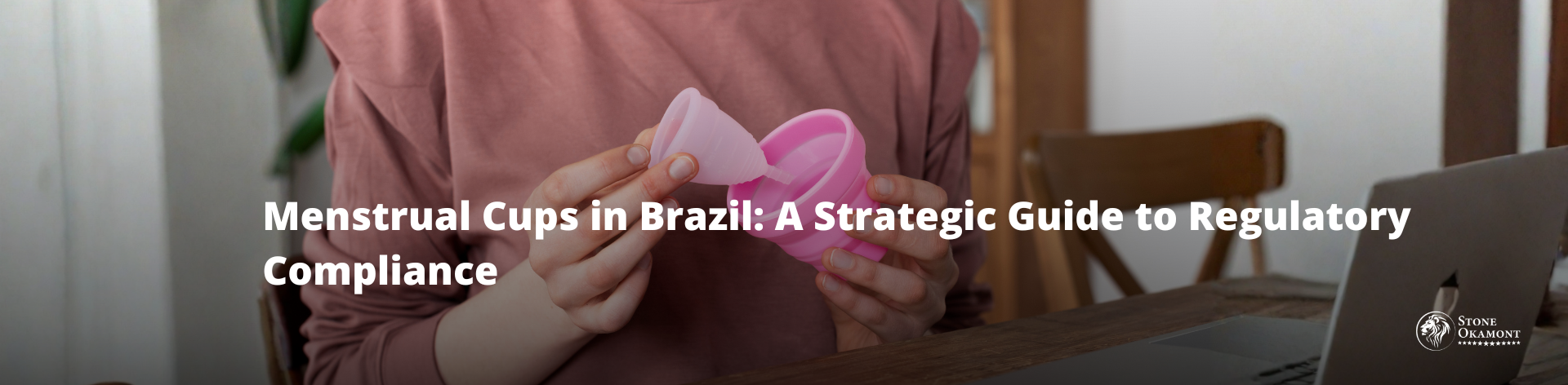
Menstrual Cups in Brazil: A Strategic Guide to Regulatory Compliance under RDC 640/2022
In this article, we will explore what a menstrual cup is, its function, and the necessary steps to regularize it according to current Brazilian guidelines—including the critical updates brought by RDC 640/2022 to the personal hygiene sector.
What is a Menstrual Cup?
A menstrual cup is a reusable, bell-shaped device designed as a physical barrier to collect menstrual flow. Unlike tampons or pads, it stores the fluid for later disposal. With a lifespan of up to 10 years, the cup is a sustainable and cost-effective option.
Hygiene is straightforward: it requires washing with running water and mild soap during the cycle. Before the first use and at the end of each period, sterilization in boiling water is essential. These care steps, combined with high-quality raw materials, ensure safety and well-being during use.
Steps for Menstrual Cup Regularization in Brazil
Before regularizing a menstrual cup or any other health-related product with ANVISA (the National Health Surveillance Agency), you must first regularize your company locally.
- Local Sanitary License (VISA): You must obtain approval from the Local Sanitary Surveillance (VISA). This step proves that your establishment meets the necessary operational and sanitary conditions.
- Operating Authorization (AFE): Once the local license is secured, you must obtain an AFE issued by ANVISA at the federal level. This involves organizing the petition, paying the Sanitary Inspection Fees (TFVS)—a mandatory Brazilian federal tax—and submitting the company's legal documentation.
Understanding the Regulatory Framework for Menstrual Cups
Although RDC 640/2022 (a specific Board Resolution) modernized the rules for disposable hygiene products like pads and tampons, it serves as a vital benchmark for the entire sector.
In Brazil, because menstrual cups come into prolonged contact with the mucous membrane, they are classified as Grade 2 Products (High Risk/Specific Claims).
What does this mean for your business? While the documentation flow may follow simplified notification or communication rites, the company is strictly required to maintain a robust Technical Dossier. This document must prove the material's biological safety, ensuring the product is safe for prolonged intravaginal use.
What are ANVISA’s Requirements for Menstrual Cup Compliance?
In this final phase, several technical details are mandatory:
- Clear Labeling: Detailed instructions for use and risk warnings in Portuguese.
- Material Safety: Evidence that the material is non-toxic and free of fragrances or odor inhibitors that could cause adverse reactions.
- Usage Time: Precise indication of the maximum continuous usage time and guidance on disposal and sterilization.
Even for products with simplified notification procedures, ANVISA maintains strict oversight. The evaluation of raw materials and sterilization controls are critical points where the agency ensures consumer trust.
What is the Ideal Path for YOUR Company?
Although menstrual cups are subject to a Notification process (rather than a full pre-market registration), this does not mean the process is simple. Incorrect frameworking, poor technical analysis of documentation, or non-compliance can lead to notifications, heavy fines, or product recalls.
Having specialized support is fundamental to ensuring all sanitary requirements are met securely and strategically.
Is your company ready to enter the Brazilian market? Contact Stone Okamont today. Our specialists will guide your process from end to end, ensuring total compliance for your product.